beatrizbrasilcaseiras@gmail.com
BEATRIZ CASEIRAS'
I grew up with Brazilian folktales, particularly captivated by the female characters in them. Investigating the historical roots of these folktales, I realized colonial hierarchies influenced how they were preserved, often distorting them to align with a Western “ideal.” As a result, the women in these tales became diluted or forgotten entirely.
I had perviously thought of colonialism as a relic of the past. In 11th grade, a class on post-colonial literature expanded my worldview, I was astounded by how colonialist theory permeates every aspect of our society. Having so much of my history rooted in a colonial system that erased stories it considered unflattering, the picture of my past had always been blurry, so I set out to gain clarity.
This new perspective prompted me to reconsider my approach to art. I began to think about how I could use my work to reconstruct a more authentic version of the past. By depicting the overlooked women of Brazilian folklore, I hope to preserve the oral traditions that colonialism has suppressed. Additionally, I seek to better understand my culture’s historical views on women, my place within these narratives, and how these perceptions have influenced my identity.
Although I have primarily worked with oil on canvas up to this point, I have also sought to incorporate experimental elements by exploring a variety of materials. Incorporating textile elements into my pieces deepens their meaning; for example, I use traditional Brazilian crochet and stitching techniques to emphasize the cultural background behind my work.
Artistically, I aim to study the underlying socio-cultural and psychological frameworks that shape our perceptions of desirability, exploring why certain forms or ideas are deemed more valuable than others.
Creating artwork that is deeply personal but also resonates with a diverse range of audiences, regardless of their individual experiences, is extremely important to me. I believe that art is most meaningful when it connects with people and challenges the world around us.
PORTFOLIO

BEATRIZ CASEIRAS
Artist
Selected Works
Selected Works
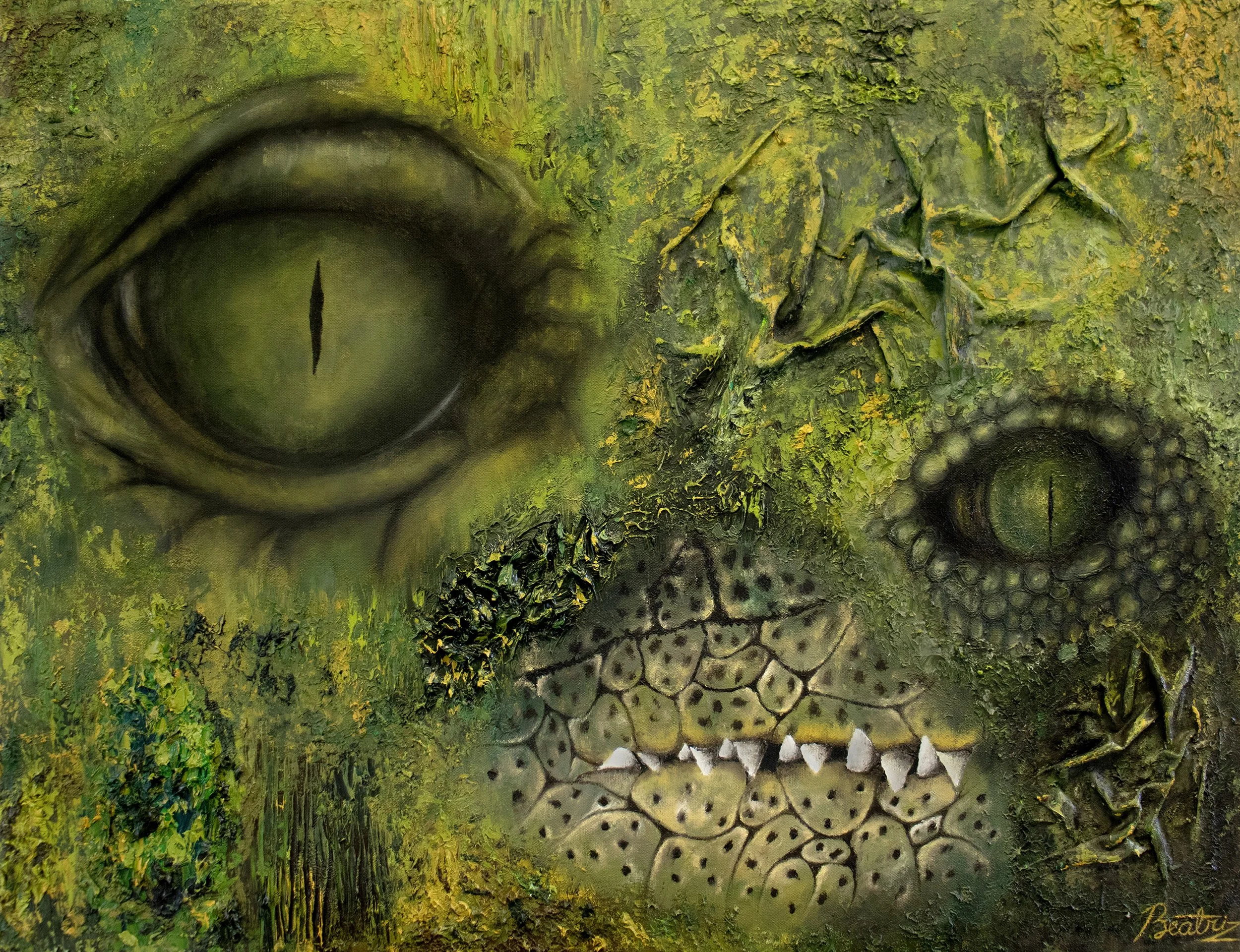
Cuca
23.6” x 31.5”
Oil on calico fabric and canvas
Much of my artwork explores the representation of women in Brazilian folklore in order to gain a deeper understanding of the narratives that shape female perception within my culture. In this piece, I aimed to depict the “Cuca", a mythical figure from Brazilian folktales, who is half-woman and half-crocodile. Her frightening appearance is meant to discourage bad behavior in children, and as a little girl, I was terrified by her. By casting a female figure as a monster who preys on the vulnerable, the folklore and its reinterpretations over time reinforced misogynistic fears of women’s power and independence. This depiction aligns with a historical pattern of portraying women who deviate from societal norms as dangerous, rapacious creatures. I imagined her in her habitat, and to replicate the texture of the swamp she inhabits, I used draped calico fabric as an additional element of texture, alongside thick layers of oil paint.
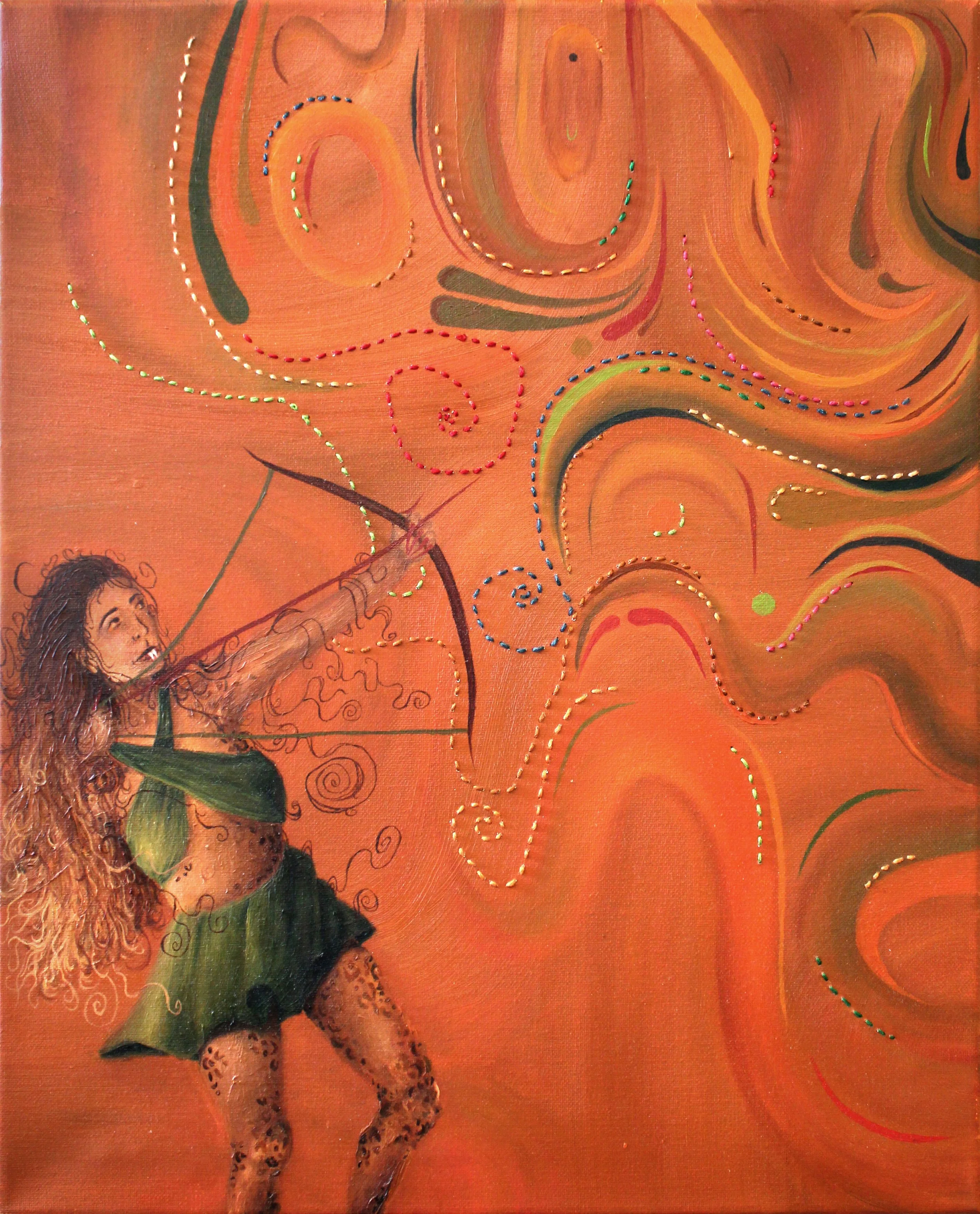
Kianumaka-Manã
20” x 16”
Oil and embroidery on canvas
In the Brazilian folktale “Kianumaka-Manã”, a woman who was originally an Indigenous girl named Yndaiá transformed into a jaguar to hunt for her community, which had gone hungry. Over time, Yndaiá became the warrior “Kianumaka-Manã", embodying the strength of jaguars to avenge her family, whom the invaders had persecuted. The tale is connected to the history of the Xakriabá people, representing the tension between Indigenous tribes and cattle ranchers who occupied their land. To incorporate the culture of the Xakriabá people into my painting, I researched their traditional clothing and tattoos. To further illustrate her spirit of a jaguar, I depicted her with fangs and sharp nails. I used abstract swirls of paint paired with swirls of stitching to create a sense of the jungle’s liveliness and energy. The stitching represents its traditional use as repair and mirrors the way folktales change over time through interpretation and retelling.
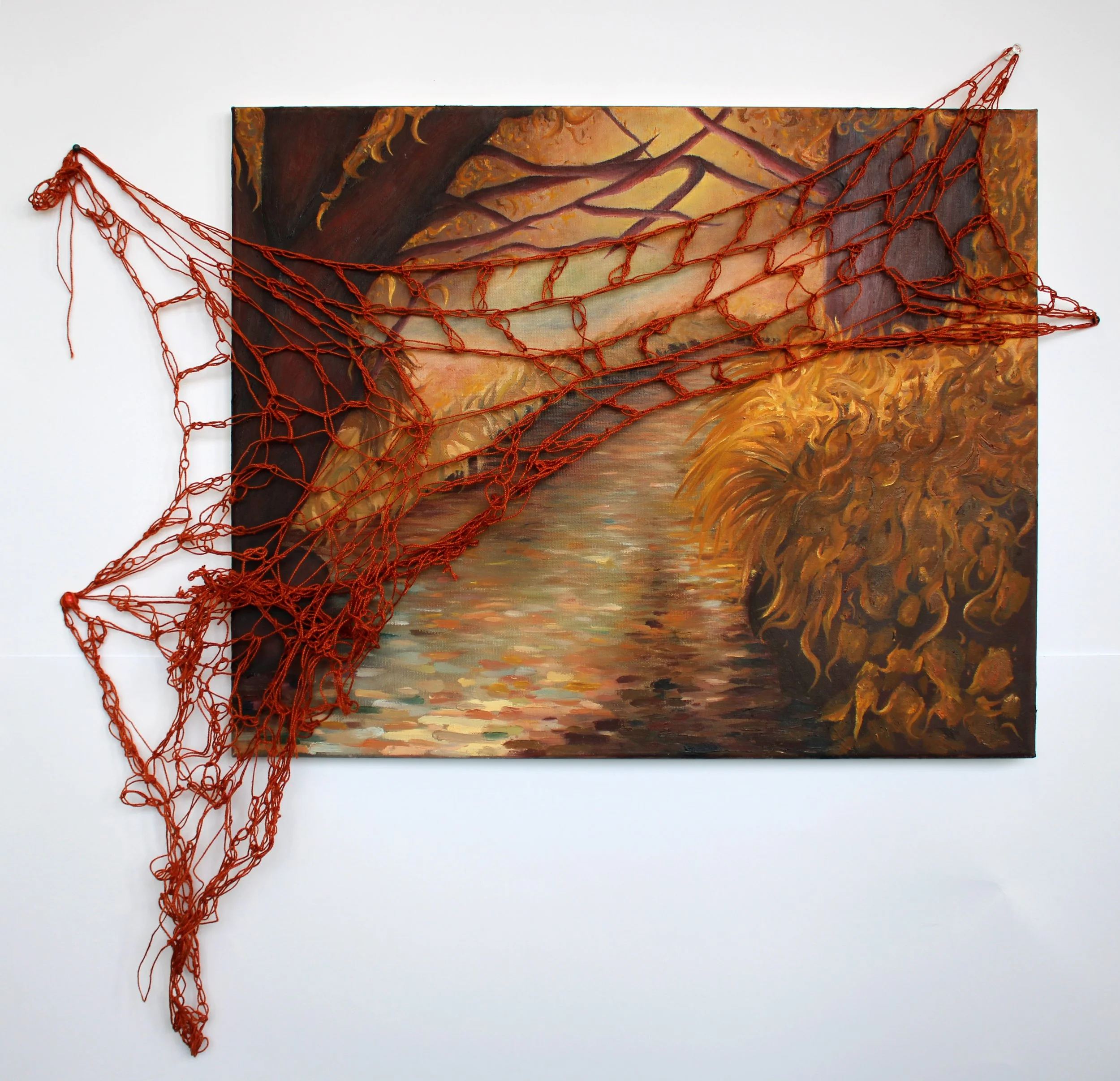
Mãe de Ouro
16” x 20”
Oil and yarn on canvas
The “Mãe de Ouro” folktale tells the story of a beautiful woman who occasionally transforms into a glowing fireball. She is regarded as a heroic protector of nature and a mythical treasure, safeguarding Brazil's gold from colonizers and defending the land against exploitation. In my painting, the gold is represented as a warm-toned landscape, suggesting that the true treasure lies in the Brazilian land itself. To emphasize her role as a protector, I researched traditional Brazilian crochet techniques and used these to add a burgundy crochet "net" over the glowing landscape. Crochet holds significant cultural importance in Brazil, and its woven structure serves as a form of defense. The burgundy color was chosen to symbolize her connection to fire.
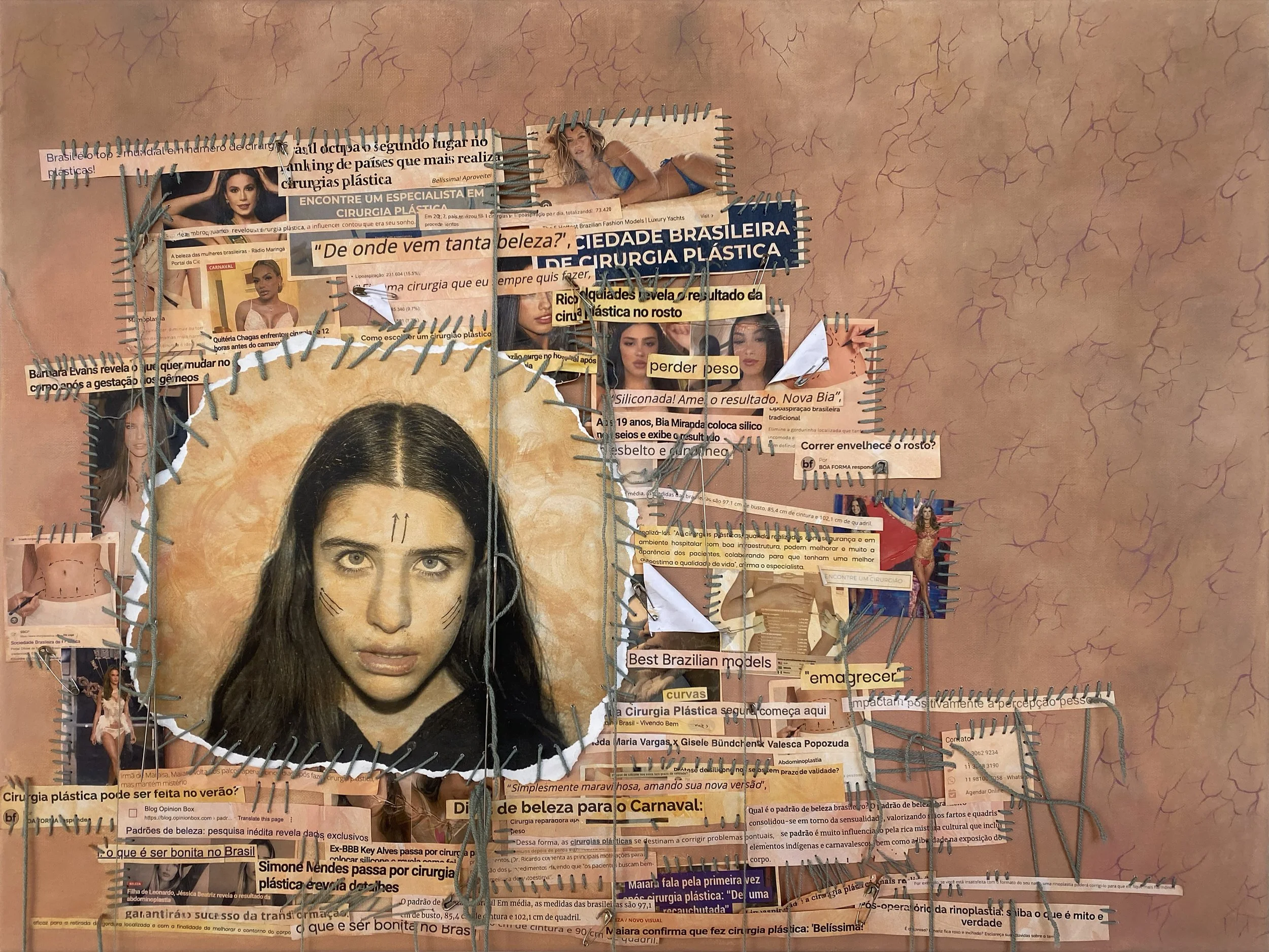
Brazilian Beauty Standards
23.5” x 31.5”
Mixed media
This piece was created around the theme of ‘Re-Framing’ and reinterprets Brazil’s beauty and plastic surgery industries. I have grown up witnessing the harmful themes in the beauty industry becoming more prevalent in Brazilian society, and I wanted to expose how deeply the pursuit of perfection has become embedded in Brazilian identity. I combined oil paint, paper, yarn, and needles on cardboard to produce a collage that symbolizes the reality of plastic surgery in Brazil and its harmful focus on altering one’s appearance. The central figure’s lifeless expression reflects the exhaustion and loss of authenticity caused by these ideals, and the surgical markings on her face reference the constant pressure to alter oneself. The orange and green tones unify the work, with the green symbolizing the illusion of beauty.
Misremembered
18” x 14”
Oil on canvas
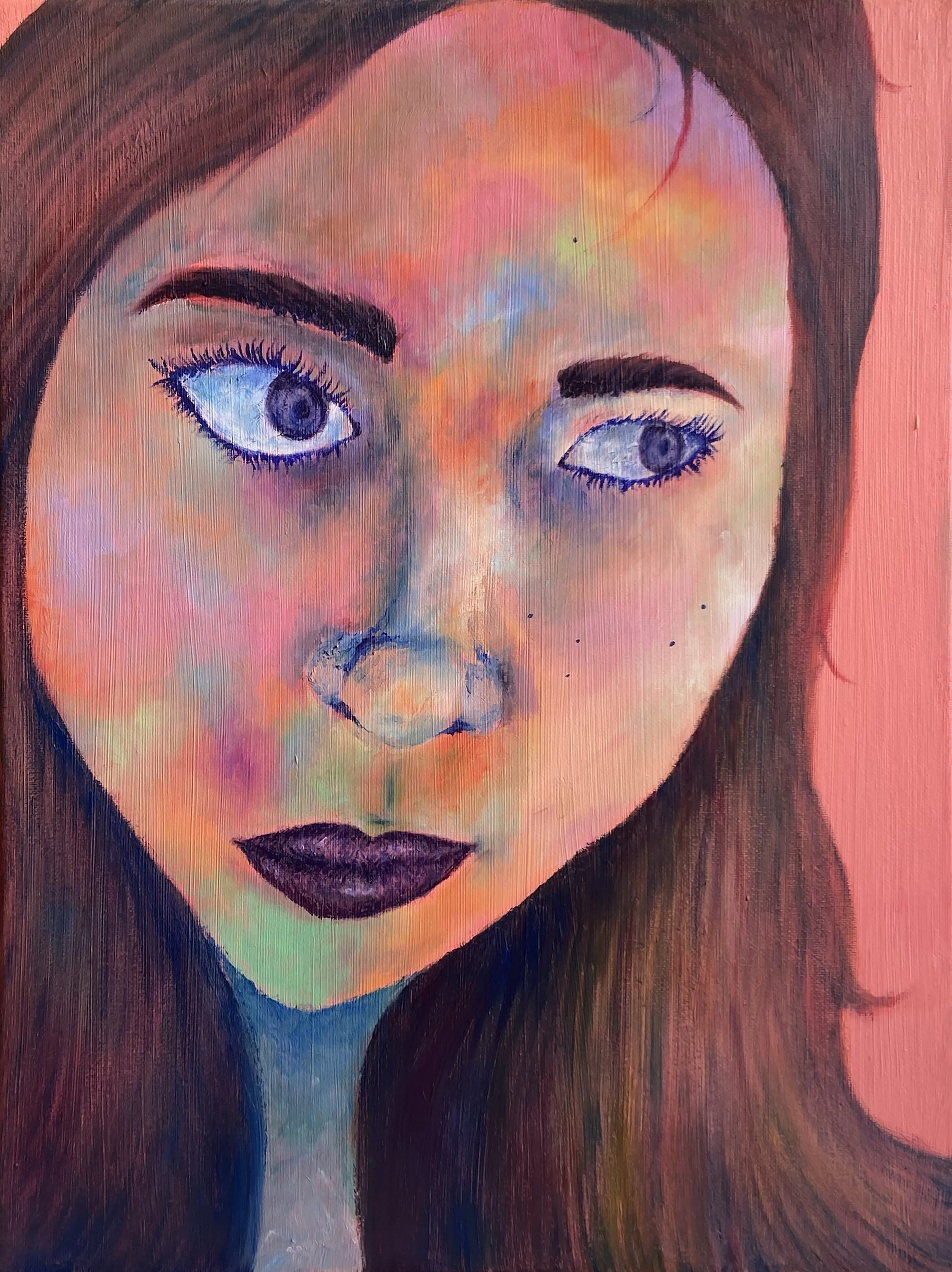
This piece was in response to a class assignment answering the theme of ‘Re-Mixing’. I aimed to do this by reinterpreting a childhood drawing. My goal was to capture the feeling of nostalgia through color while also exploring the mystery of memory itself. I researched how colors can evoke emotions and chose hues often associated with childhood. I blended these colors in a dreamlike manner to create a sense of unease and explore the warped perception of childhood memories. The flat appearance of this piece was intended to make the piece feel enigmatic and to symbolize revisiting the past through a new lens.
Simple Beauty
18” x 18”
Oil on canvas
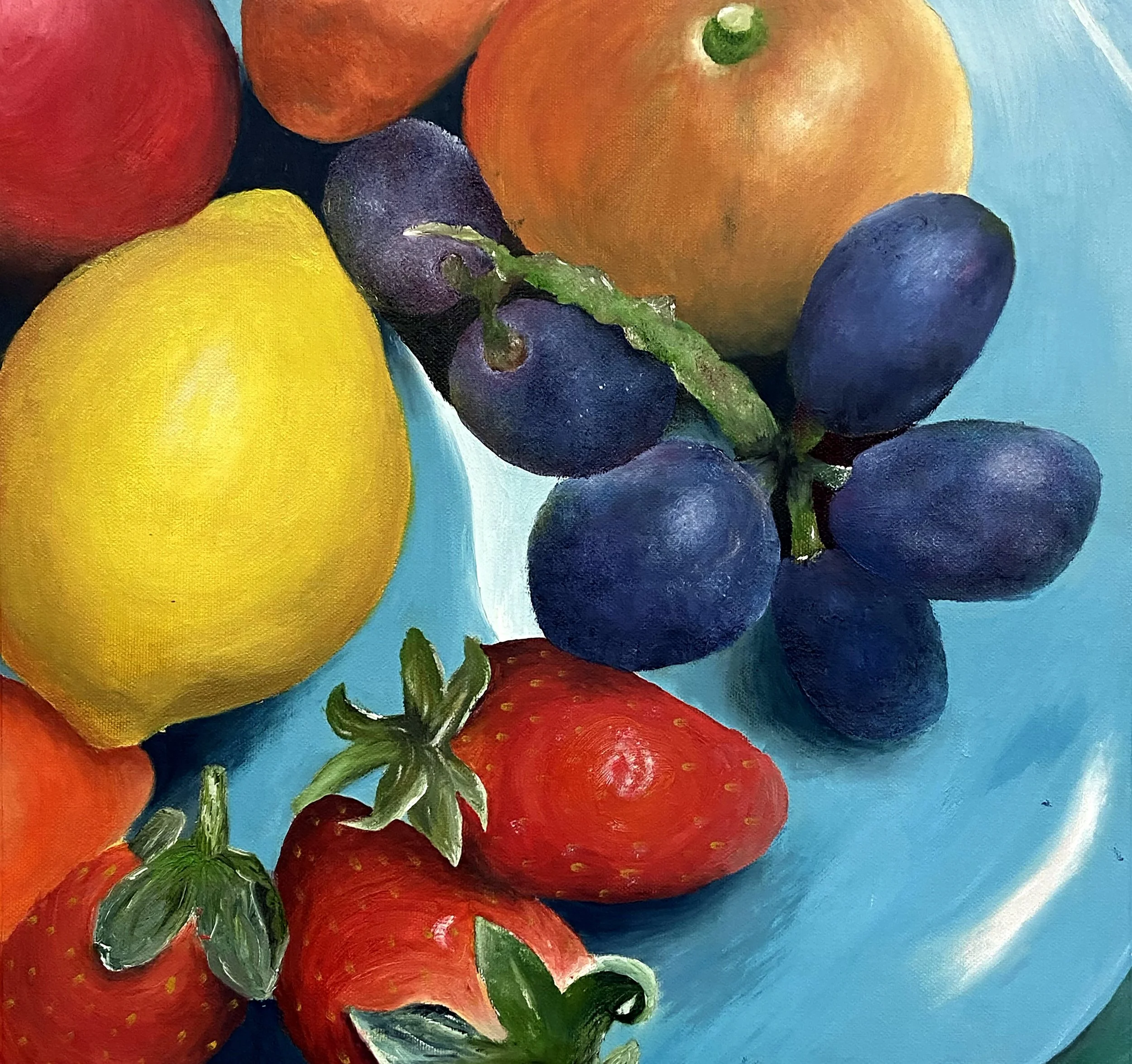
This art project represents my first attempt at working with oil and painting a still life. The class assignment was to paint a plate of fruit. Working from observation, I began to notice the beauty in each fruit, appreciating its color and texture. I focused on capturing the beauty found in such simplicity and aimed to portray the transient nature of these items. In this work, I concentrated on using rich colors to enhance the vibrancy of each fruit. I also worked on highlighting the light and texture present in the fruit arrangement to create a sense of realism and depth.
Distorted Perception
20” x 16”
Oil on canvas
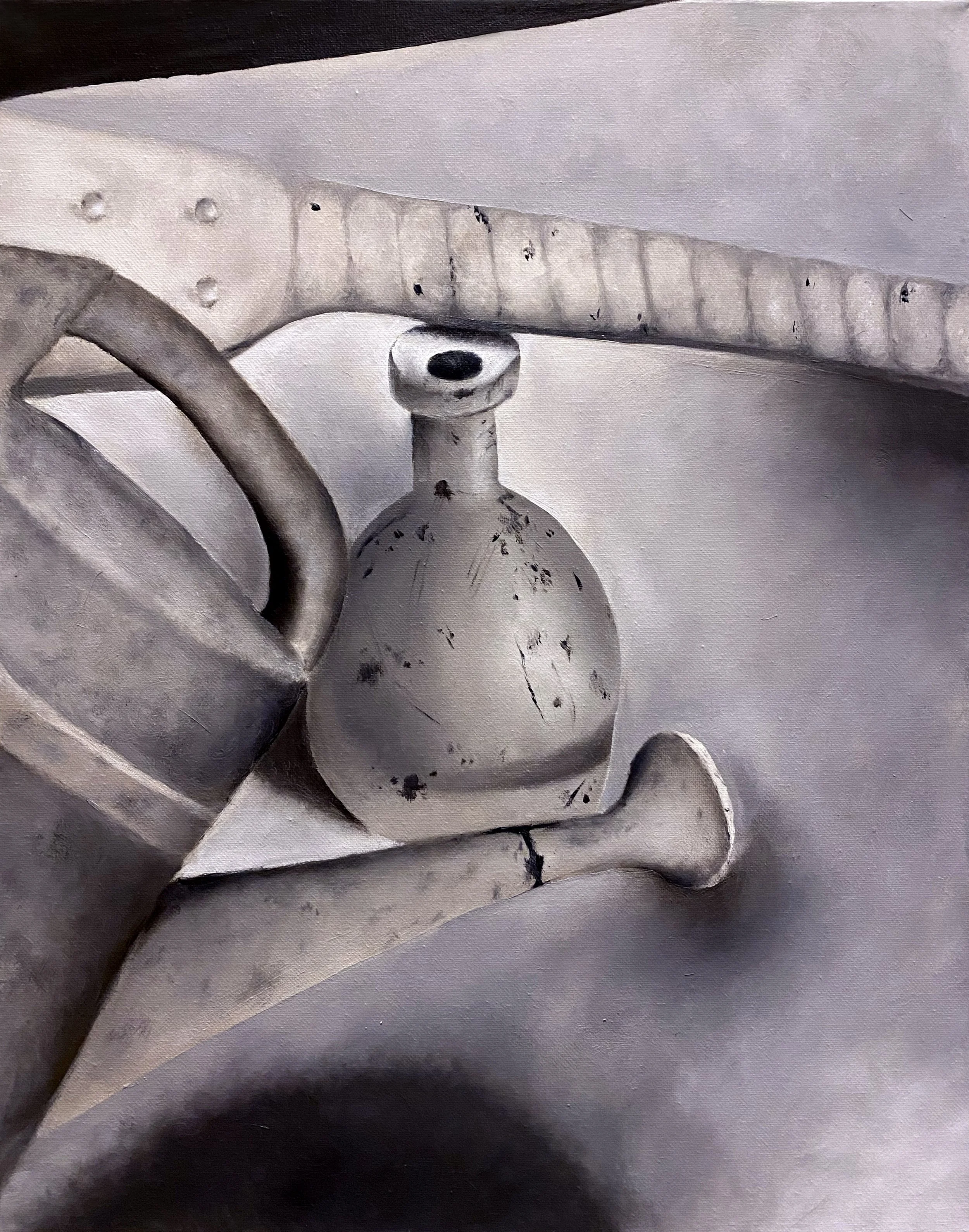
This black and white still life was created at the Columbia Pre-College Program as part of an observational painting exercise where I explored form and perception. In this work, I set up a bright light source and, using a grayscale palette, I concentrated on the subtle gradation of hue and tone. I explored a distorted perspective to challenge how everyday items are perceived, and depicted idealized objects by using smooth color blending. This piece was influenced by Giorgio Morandi and his representation of the quiet stillness of ordinary forms, as well as the subtle variations in tone and perspective that evoke introspection.
Pisadeira
23.4” x 33.1”
Mixed media
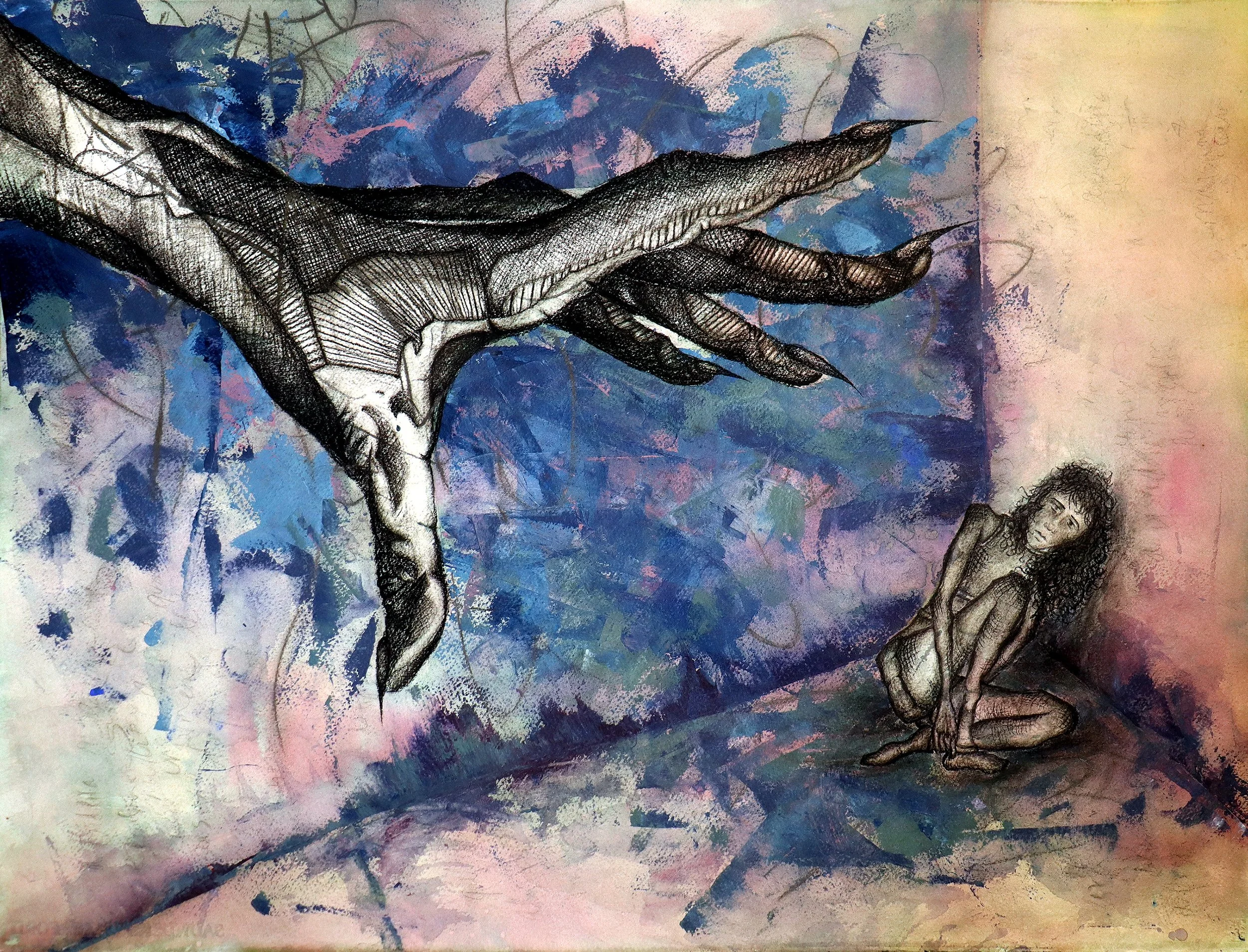
Represented by the hand, this piece depicts the Brazilian folktale of “Pisadeira”, a sleep demon that is the personification of nightmares, created to explain the phenomenon of sleep paralysis. She creeps in on her victims, stomps on their chest, and paralyzes them while the victim remains conscious and unable to move. My research on artist Sibylle Peretti influenced my palette through her use of cold hues. To highlight the storytelling nature of folklore, I wrote a rendition of the tale using graphite as the base of the artwork and layered ink and later acrylic paint over it. I also created expressive marks using graphite, both behind and in front of the acrylic. I used cross-hatching with charcoal to make her hand, emphasizing sharp and geometric angles to evoke an eerie presence. I aimed to convey her enduring power by using a distorted perspective that exaggerated the size of her hand in comparison to the figure, emphasizing her suffocating power and control over the vulnerable.
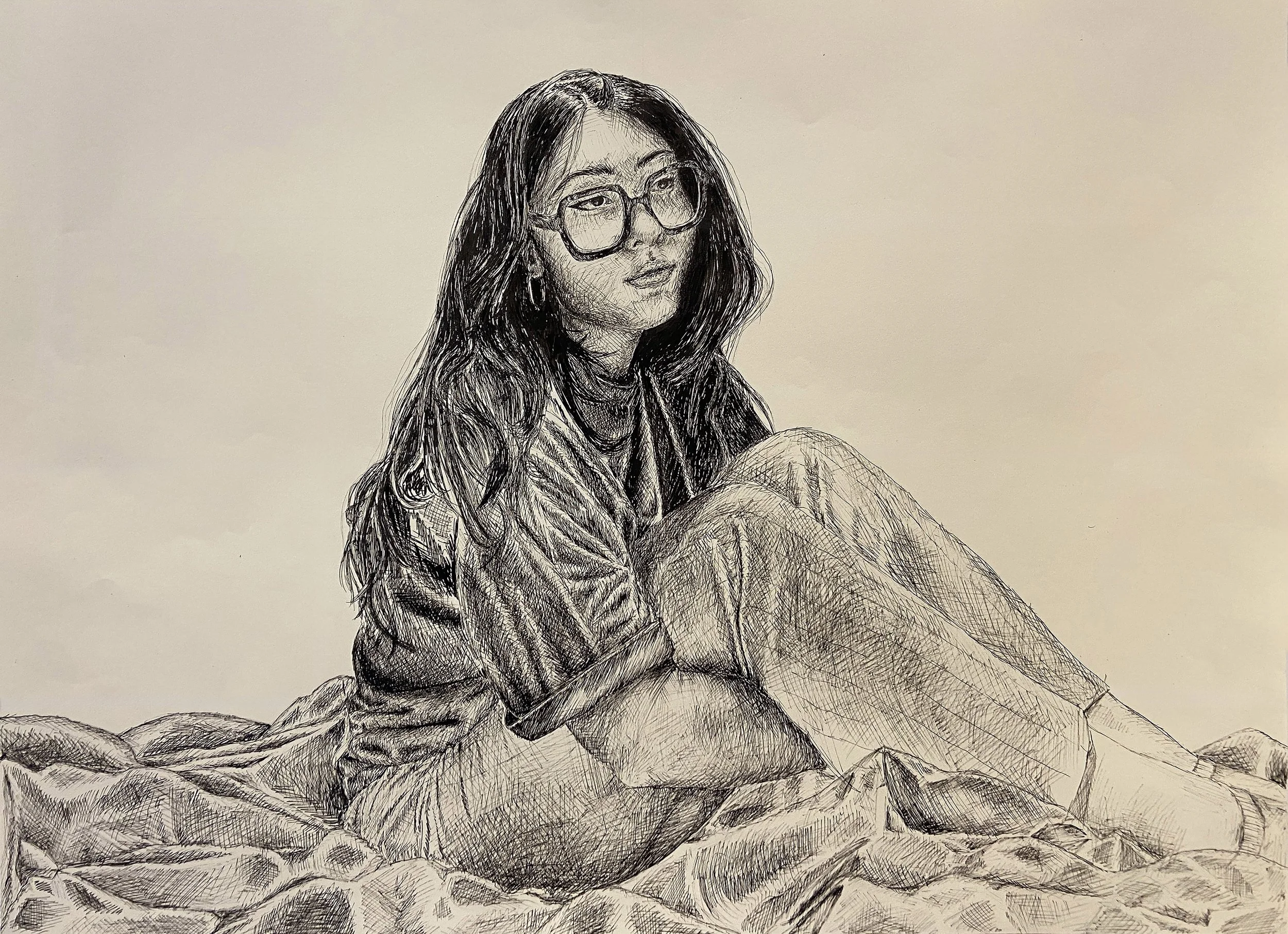
Pyjamas Three Inches Too Short
18” x 24”
Ink on paper
I find that at times, I unconsciously put up a front. In this piece, I wanted to break down this front and depict myself through a lens most don’t usually see me through. To achieve this, I created a self-portrait in my most vulnerable state, in my room at night. This depiction of myself is what I consider the truest. Wearing an oversized shirt and pyjama pants that are a few inches too short, not hiding behind a passive exchange of small talk, but instead letting my expression rest in the exhaustion of the day, mentally preparing myself for another one tomorrow. Drawing with a pen, there are hundreds of things that could go wrong. It is permanent and irreversible, but so is life. In this way, the ink represents all the actions I have taken throughout my life, all of which are irreversible and all shaping who I am today.

Princesa Encantada de Jericoacoara
56” x 25”
Calico fabric, acrylic, wire, and thread
The tale of the “Princesa Encantada de Jericoacoara” tells of Princess Carolina, whose body was turned into a serpent with golden scales by an evil sorcerer. The inspiration for this outer garment comes from the process of snakes shedding their skin, realized through a three-dimensional visual interpretation. Using tubing, wire, gauze, and fabric, I sewed this garment, meant to be worn as a sculptural piece over an evening gown. Using a light fabric and gold thread, I reproduced the transparent intricacy of a snake’s molted skin. To depict the water element that Carolina inhabited, I sewed tubes of calico fabric and hand-dyed them blue. This process resulted in tubes of fabric with a variety of shades of blue, mimicking the movement and hues of the river she lived in.
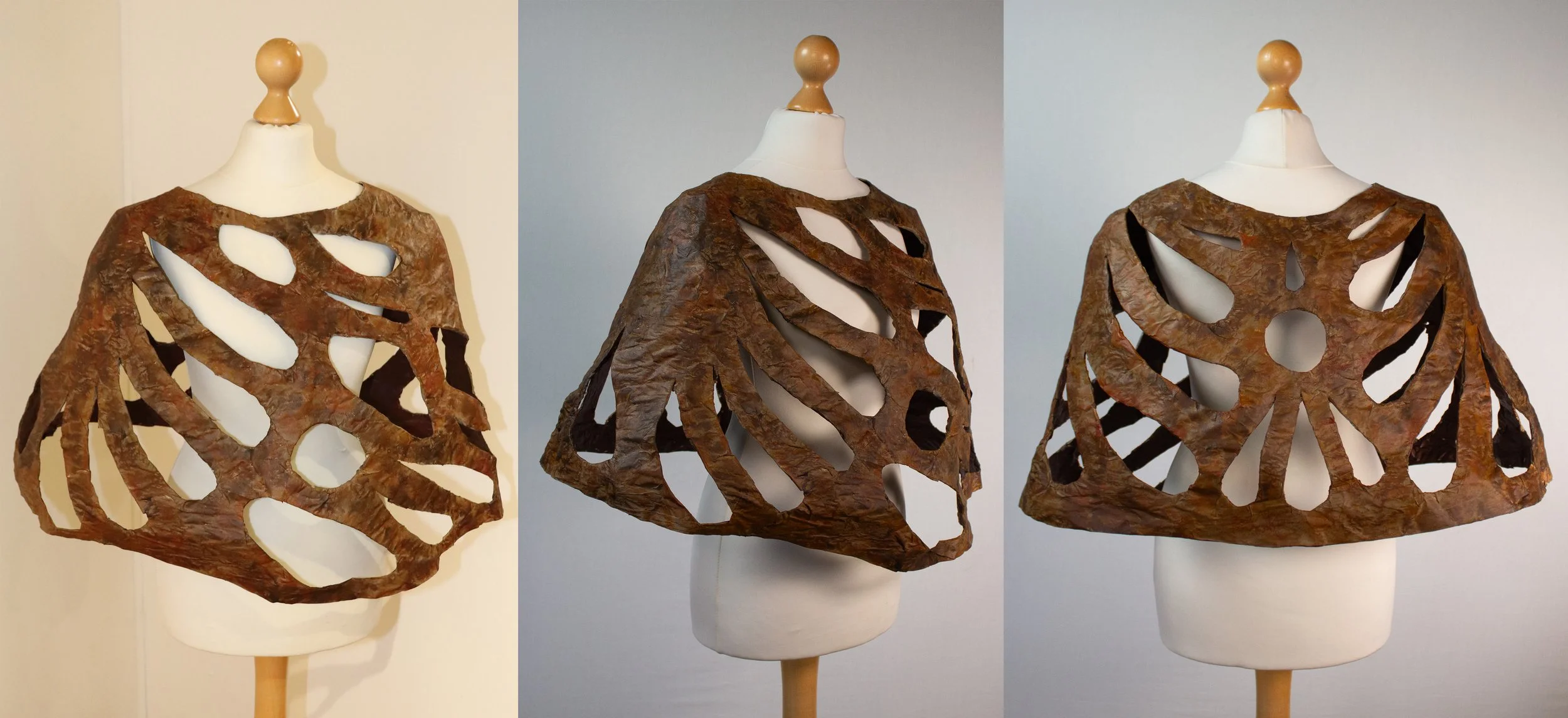
Andurá
23” x 30”
Papier-mâché and acrylic
The Brazilian folktale "Andurá" tells the story of an Indigenous girl named Anahi, who sacrifices her life to save a cockspur coral tree. Jaci, the moon goddess, and Anhangá, an ancient deer spirit, reincarnate her soul into a tree called "Andurá," which spontaneously combusts every full moon without disintegrating. In my 3-D artwork inspired by this tale, I used papier-mâché to create a rough texture that resembles that of a tree. I cut holes in the papier-mâché to form a shape depicting a more organic structure, reflecting nature without being overly explicit. After cutting, I sealed the papier-mâché with additional paper to give it a polished appearance. When it came time to paint the piece, I began with a brown base and gradually added darker shades of brown, orange, and red to subtly highlight the variety of colors and textures found in trees. I painted the inside burgundy to symbolize the fire that emerges from Andurá every full moon.
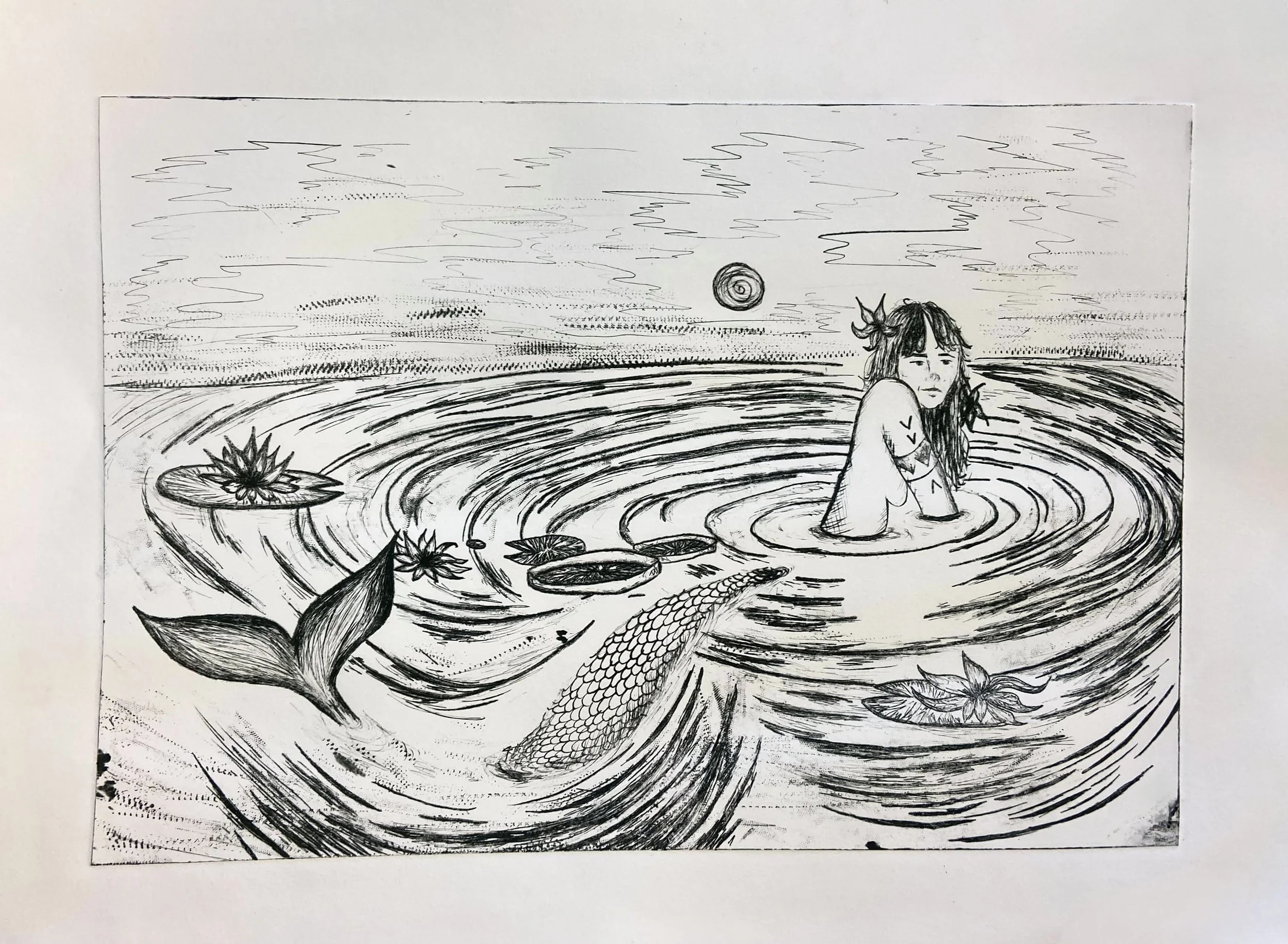
Serenity
11” x 15”
Drypoint etching
This drypoint etching reimagines the Brazilian folktales of Iara and Naiá, which I merged into a single piece. Traditionally, both stories portray a metamorphosis through tragedy, but I sought to reinterpret the tales using a calmer lens in order to transform their tragic stories into ones of serenity. I used drypoint needles to carve into a plastic plate and create a variety of lines and textures that suggest the water's movement. Printing on bread and butter paper allowed the ink’s variations to enhance the softness of the scene. This reinforced the tranquility I wanted to bring to these figures. I included a tattoo based on research into traditional tattoos of the Tupi-Guarani people (to which Iara and Naiá were both said to belong), in order to represent an important cultural aspect and bring Indigenous cultures to light.
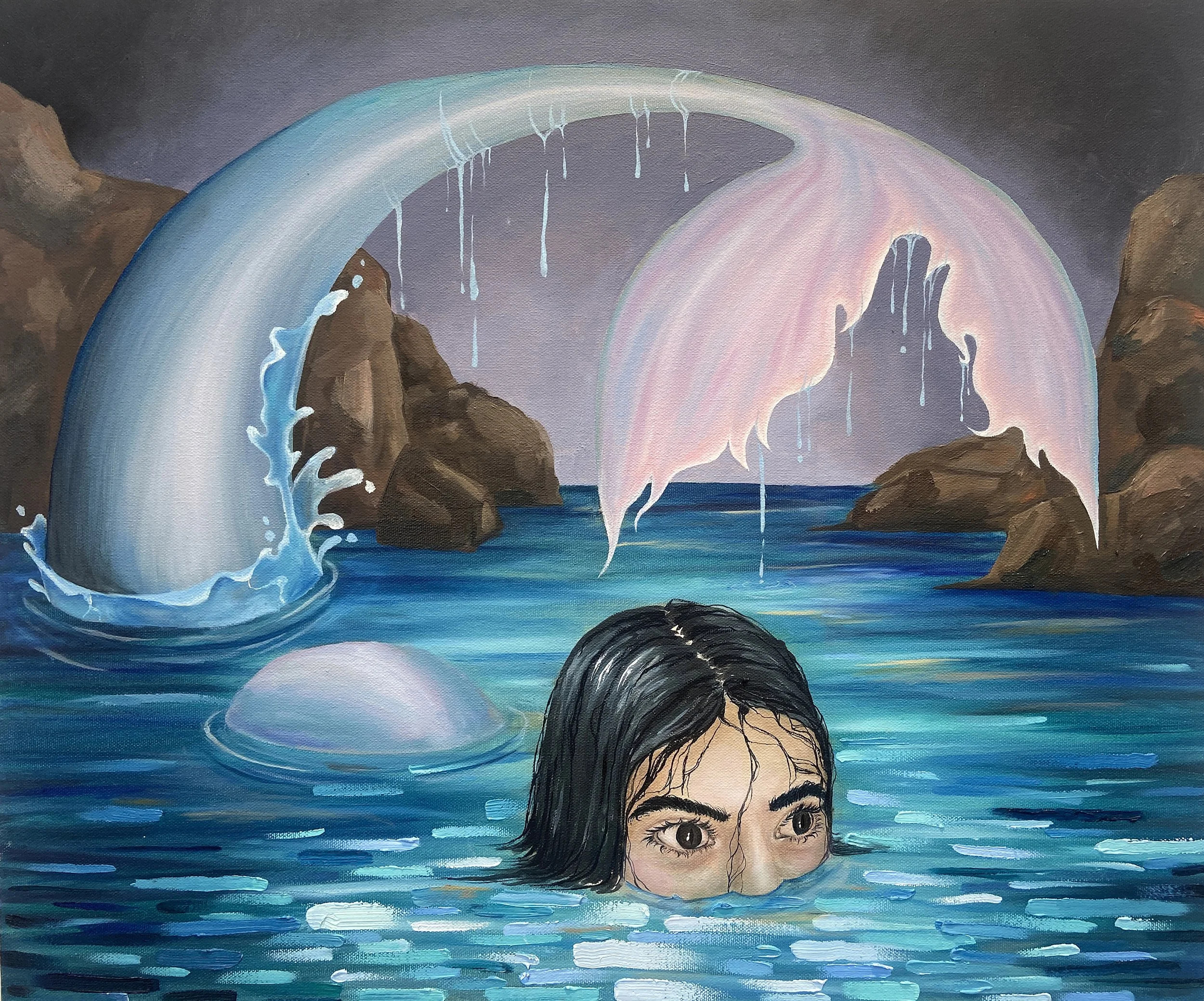
Iara
20” x 24”
Oil on canvas
In another Brazilian folktale, Iara was a skilled warrior whose jealous brothers tried to kill her. After killing them in self-defense, Iara was drowned by her father. The moon goddess, Jaci, transformed her into a mermaid out of pity. With her enchanting voice, Iara lures men to the bottom of the river, where they are either drowned or live with her until they die. When researching this myth, I began to believe that Iara's longing for human connection was driven by loneliness, as her immortality condemns her to an eternal state of solitude. I sought to convey this isolation through the stillness of the water, as well as by making her the sole subject in the composition. Iara personifies the natural world, with its alluring and perilous nature, and I attempted to depict this sense of discomfort she embodies by creating a contrast between her eerie face and the serene background.
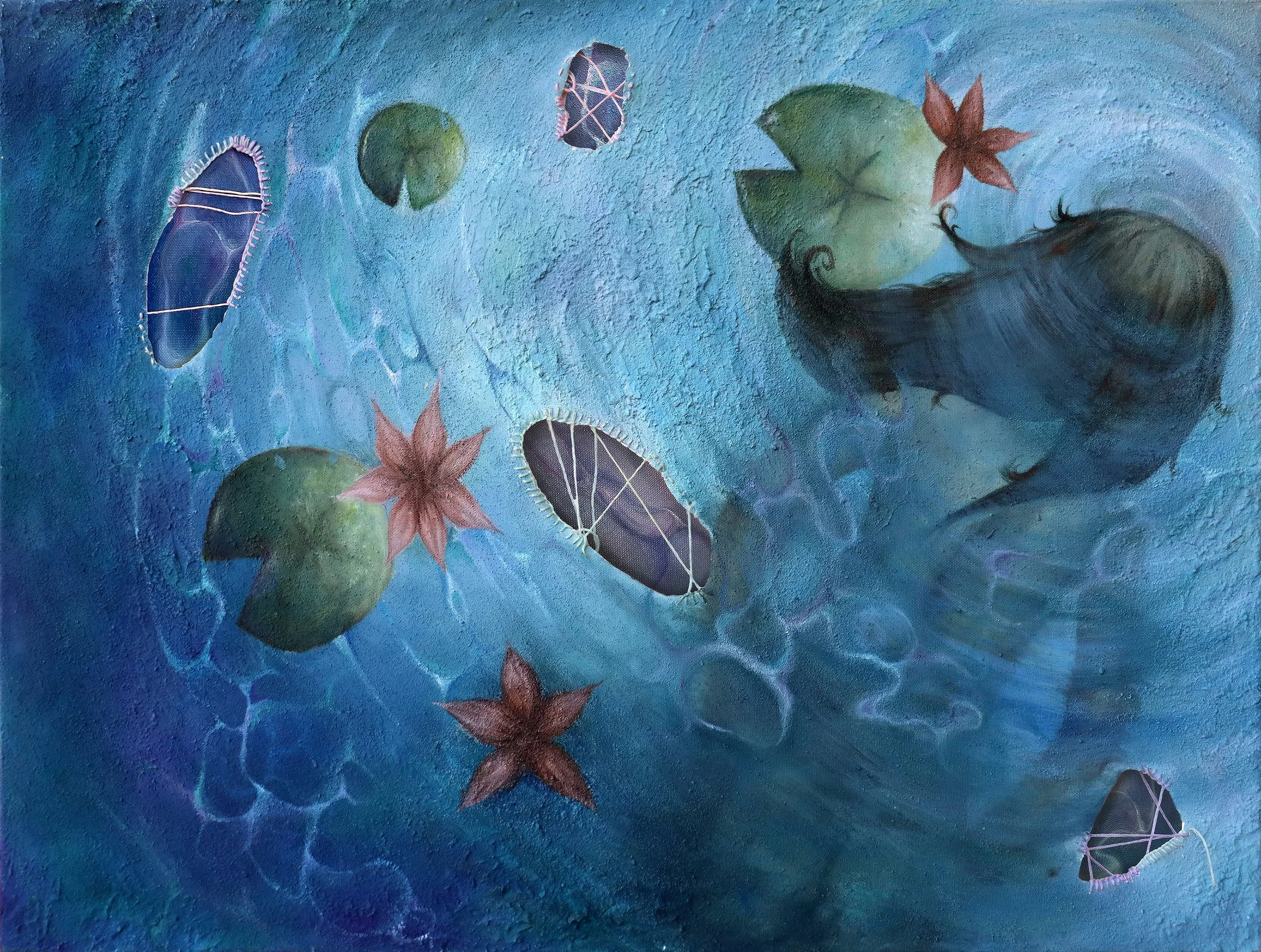
Vitória Régia
23.6” x 31.5”
Oil on canvas and mixed media
The Brazilian folktale “Vitória Régia” tells the story of a girl named Naiá, who was so in love with the moon that she drowned in a river while trying to embrace its reflection. To honor Naiá's devotion, the moon goddess Jaci turned her into the "star of the waters," the giant water lily, Victoria amazonica. The holes in the painting reveal another narrative layer, representing how the significance of this folktale has gradually been lost and reinterpreted over time. I experimented with marble powder and sand to create texture, aiming to illustrate the degradation of the folktale over time and its evolving nature. I also examined how Naiá's portrayal influences modern Brazilian culture, looking at how her metamorphosis into a water lily illustrates the close relationship between Indigenous traditions and Brazil's natural environment.
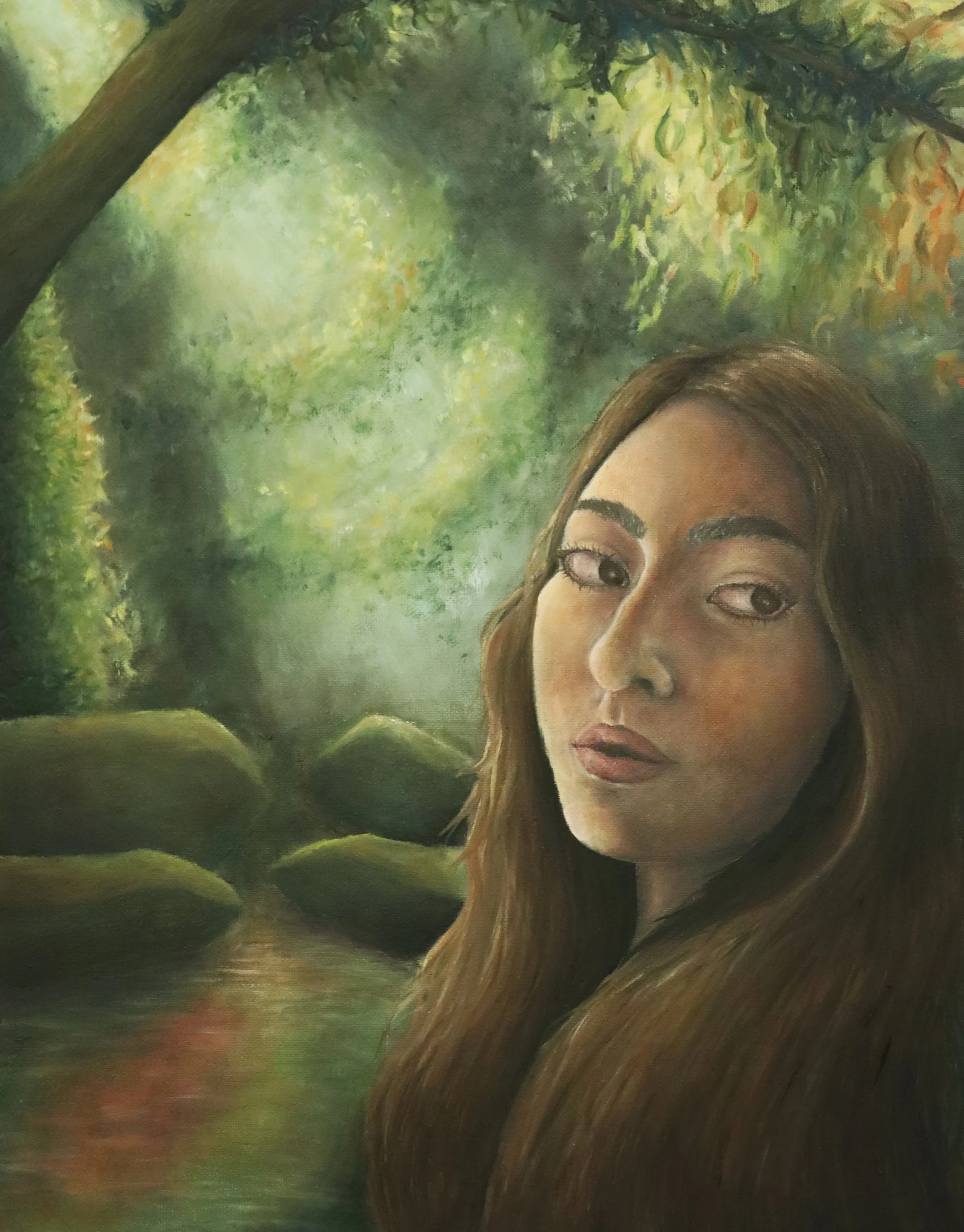
Frozen in Time
17.8” x 14”
Oil on canvas
In this self-portrait, the background is inspired by the Brazilian folktale "Mapinguari", a monstrous creature that resides in the Amazon rainforest. I aimed to capture the story's tone by creating a dreamlike atmosphere through layering oil paint and building up color to produce depth and a translucent effect. I wanted to portray myself as a girl from Brazilian folklore who has been forgotten over time, leaving her story untold. Through this portrayal, I aimed to depict the pain of the erasure of stories and perspectives, especially those of Indigenous peoples, through systemic violence and oppression, which I represented by leaving her mouth open and her gaze lingering to the side. Hopefully, my profound identification with my cultural roots comes through in this work, which is one of my favorites.